How to open a hair salon or barbershop in Spain: paperwork, permits and what it costs to get started
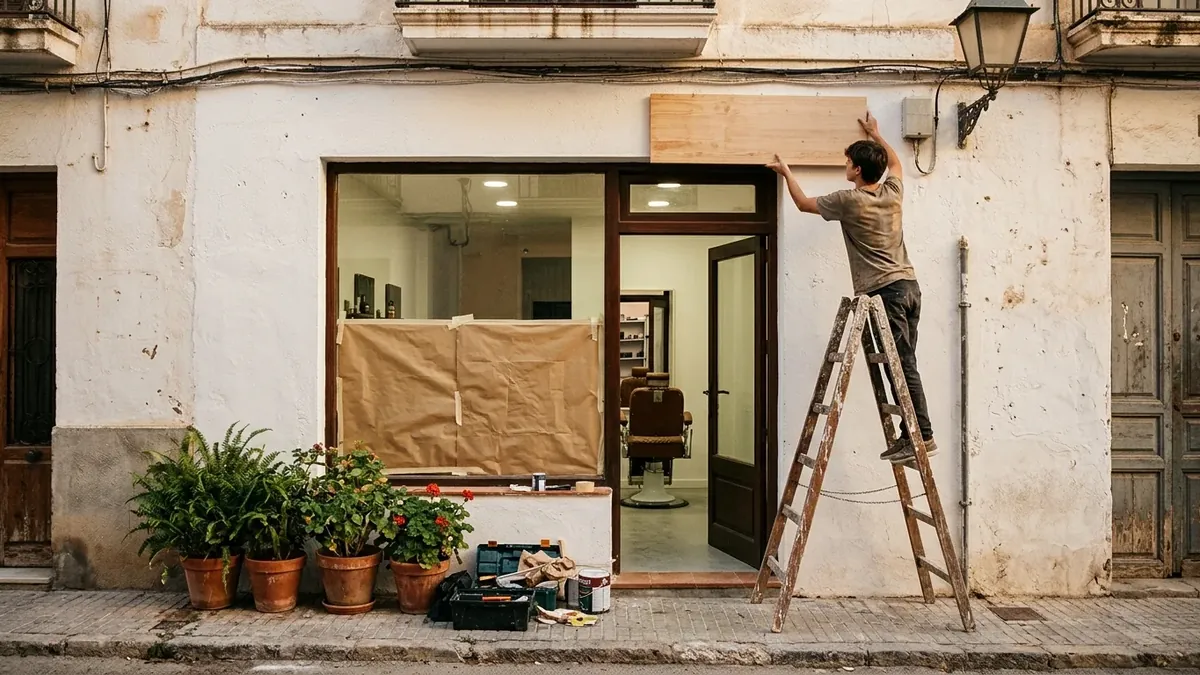
There is a moment, usually on a Sunday afternoon, when you walk past an empty shop with a «Se alquila» sign in the window and picture yourself inside: the chair by the window, your name on the glass, the radio on. You have spent years working for someone else, you have clients who would follow you, and in your head the numbers work. What is far less clear is everything else: which paperwork you need, in what order, how much money you need before you charge for your first haircut, and what happens if you sign the lease and then the town hall raises objections.
That is what this guide is about. It is not a legal manual, because many of the requirements change from one town hall to another and from one region to the next, but it is the full map, so you know what to ask, who to ask and when. At the end you will find an eight-week timeline, the mistakes that cost the most and the questions we hear most often.
Before the paperwork: three decisions that shape everything
On your own or with someone. Opening with a partner splits the investment and the hours, but it also splits the decisions. If you go in together, put in writing before you open who puts in what money, how many hours each of you works and what happens if one of you wants out. It sounds like mistrust; it is exactly the opposite.
Self-employed or a company. Most small hair salons and barbershops in Spain start with the owner registered as self-employed (autónomo): it is cheaper to set up and to run, and there is less paperwork. A limited company (sociedad limitada) makes sense when there are several partners, when you plan to hire more people or when the investment is large and you want to keep your personal assets separate from the business. It is a decision to make with an accountant (gestoría) and your own numbers in front of you, not one to copy from an acquaintance.
An empty unit, a going concern or a rented chair. Taking over a salon that was already trading (a traspaso) saves you building work and brings local clients; in return you pay for it and you inherit the previous owner's reputation, good or bad. An empty unit lets you do things your way, with more work and a longer wait. And there is a third route that is becoming more common: renting a chair in someone else's salon for a few months to check how many clients really follow you before you commit to a five-year lease.
The premises: what to check before you sign
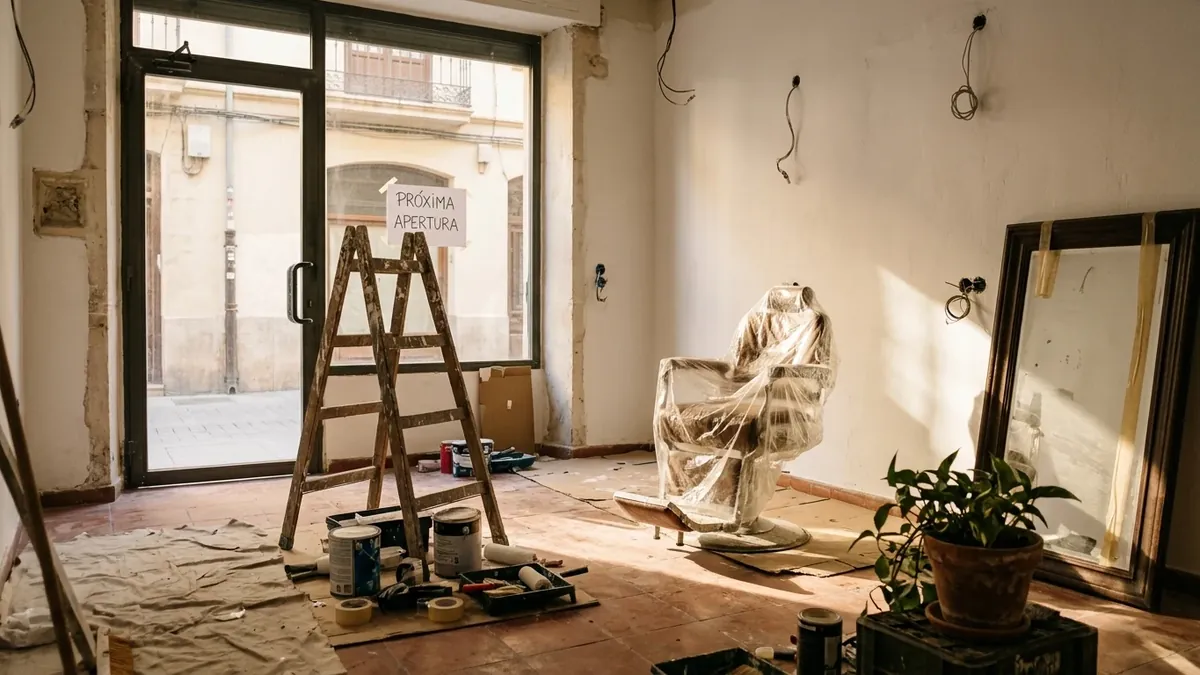
The most expensive mistake you can make when opening a salon has nothing to do with the tax forms: it is signing a lease on premises where you are then not allowed to trade, or where adapting the installations costs twice what you expected. Before you sign anything:
- Ask the town planning department whether the activity is permitted. Many town halls answer a prior enquiry or issue a planning compatibility report (informe de compatibilidad urbanística). It takes a few days and removes the biggest risk of all.
- Hot water and drainage where the backwash will go. Moving pipes under the floor is serious work. Find the drain stack and check whether the basin can go near it.
- Ventilation. Colouring, bleaching and some straightening treatments need fresh air. Ask what your local by-laws require.
- Toilet and accessibility. Depending on the size of the unit and local rules, you may need an accessible toilet or step-free access. If there is a step at the door, ask beforehand.
- Electrical capacity. Dryers, straighteners, water heater and air conditioning running at once add up. Check the contracted power and the state of the fuse box.
- Rent-free months. It is common to negotiate one or two months without rent while the works last. Get it in writing in the lease, together with who pays for what if building installations need changing.
If you are taking over an existing salon, ask the previous owner for their opening documentation and check with the town hall whether a simple change of ownership is enough. It is usually quicker and cheaper, but not always possible: if the activity changes or the premises no longer meet current rules, you have to start from scratch.
The formalities, in order
None of them is particularly hard, but the order matters: some things cannot be filed without others, and some deadlines start running the day you begin trading.
1. Registering with the tax office: form 036
You register in the census of businesses with form 036 (modelo 036), online at the Spanish Tax Agency (Agencia Tributaria) or at one of its offices. Form 037, the simplified version many people remember, was abolished in February 2025, so everything now goes through the 036. On it you state your start date, the address of the premises and your business activity code (epígrafe del IAE):
- 972.1, Hairdressing services for women and men, for hair salons and barbershops.
- 972.2, Beauty salons and institutes, if you will also offer hair removal, facial or body treatments, beauty massages and similar services.
If you do both in the same premises, the usual thing is to register under both. And one detail that saves money: if you register with the tax office before the works begin, declaring that you are starting the activities that come before opening, you will be able to reclaim the VAT on what you spend on the premises and the furniture. Raise it with your accountant before you pay the first big invoice. Hairdressing services carry 21 % VAT, the standard rate, and that VAT must be included in the prices your clients see.
2. Registering with Social Security as self-employed
Registration in the self-employed scheme (RETA) is done through Import@ss, the Social Security online portal, and can be done up to 60 days before you start. Since 2023 the monthly contribution depends on the earnings you expect, and it is adjusted later with your income tax return. If this is your first time registering, or you have not been self-employed in the previous two years (three if you have had this reduction before), you can apply for the flat rate (tarifa plana): a reduced contribution of €80 a month for the first twelve months (slightly more on the actual bill, because of the intergenerational equity surcharge), which can be extended for another twelve months if your net earnings in the first year stay below the minimum wage. You apply for it at the moment of registering; if you forget to tick it, there is no going back.
3. The town hall: the responsible declaration (and a building permit, if needed)
Since Law 12/2012 on urgent measures to liberalise trade and certain services, hair salons and beauty salons are among the activities that, in premises the size of any neighbourhood business, do not need a prior opening licence. You simply file a responsible declaration (declaración responsable) or a prior notification with the town hall, stating that the premises meet the regulations, and you can open. The town hall checks afterwards and, if something is not compliant, it can ask you to fix it or stop you from carrying on.
Two important caveats. First, if you are doing building work, you may need a works permit or a signed technical project, and that does take time. Second, every town hall has its own form, its own fees and its own way of checking, so ask for the exact list of documents before the refurbishment starts. They commonly ask for a technical report or certificate on the premises signed by an architect or an engineer.
4. If you hire someone
The day your first employee starts, you become an employer as far as Social Security is concerned, on top of being self-employed: you need an employer contribution account code, to register the worker before they start, a contract and an occupational health and safety arrangement (almost everyone outsources it to an external prevention service). Minimum pay and working hours are set by the collective agreement for your sector; your accountant will tell you which one applies.
What must be on display on day one

This is where new businesses are most often caught out in consumer inspections, and almost all of it can be sorted in an afternoon:
- Complaint forms and the sign announcing them. Each region has its own official complaint forms (hojas de reclamaciones). You can get them from your region's consumer affairs office or from the municipal consumer information office (OMIC).
- Prices on display, VAT included. On a sign or a list the client can see before sitting down. If you charge «from» a price, explain what the final price depends on.
- Your opening hours, on the door.
- Your clients' details, kept properly. As soon as you write down a name and a phone number, the General Data Protection Regulation applies: tell people what you use their data for, store it carefully and do not send promotions to anyone who has not given you permission.
- Music. Playing the radio or a playlist in premises open to the public counts as a public performance, and the Spanish collecting societies (SGAE and AGEDI-AIE) charge for it depending on the type and size of the premises. The alternative is a music service for businesses that includes those rights; keep the contract in case you are asked for it.
- Insurance. Public liability insurance is not always required by law, but it is what covers you if a bleach goes wrong or a client trips in the salon, and many leases require it. It is usually taken out together with cover for the premises and their contents.
How much it costs to open a salon: how to do the maths
There is no single figure that works for everyone: a 40-square-metre unit that used to be a salon in a small town does not cost the same as an empty 90-square-metre unit in central Madrid. What we can give you is the list of cost items, so you can ask for quotes and not miss any. The figures in the table are an invented example of a small one-person barbershop, purely to show you how the sum works; yours will come from your own quotes.
| Item | What it includes | Example |
|---|---|---|
| Deposit and guarantees | For commercial premises, usually two months' deposit, plus any extra guarantee the landlord asks for | €1,800 |
| Building work and fit-out | Plumbing for the backwash, electrics, paint, flooring, toilet | €9,000 |
| Technical project and fees | Signed report or project and town hall fees for the works and the declaration | €1,200 |
| Furniture | Chair, backwash unit, mirrors, styling station, reception desk, waiting chairs | €4,500 |
| Tools and equipment | Clippers, scissors, dryers, straighteners, steriliser | €1,500 |
| Opening stock | Product used in the chair and a small retail stock | €800 |
| Sign and branding | Shop sign, window vinyls, business cards | €900 |
| Accountant, insurance and utilities | Set-up and first months of the accountant, insurance, electricity and water contracts | €900 |
| Fixed-cost cushion | Three months of rent, self-employed contribution, utilities and accountant while the diary fills up | €4,500 |
| Example total | €25,100 |
The item most people skip is the last one, and it is the one that decides whether you last. In the first months the diary is not full, and fixed costs arrive from day one all the same. If you do not know how many clients you need to cover them, our article on how to get your first clients works it out step by step, and the one on how to price your services calculates the minimum price for each service from your costs.
Two ways to bring the figure down without it showing: second-hand furniture from salons that are closing is usually in good condition and very well priced, and many product suppliers offer opening terms (a discount on the first order, display stands) if you ask.
Grants and help worth looking into
As well as the flat rate, several Spanish regions have their own help for new self-employed workers (in some, the first year's contribution can work out practically free) and grants for investment or hiring. They change almost every year and the deadlines are short, so the best source is your region's employment website and the chamber of commerce or local development agency of your town hall. If you are receiving unemployment benefit, ask about taking it as a lump sum (capitalización del paro), which lets you receive what you have left in one go to invest in the business.
How to reach opening day with bookings already in the diary

What shows most in the first month is not whether the sign looks good, but whether there are bookings. And that is prepared while the works are going on, which is exactly when the whole neighbourhood walks past, peers in and wonders what is opening there.
- Open bookings two or three weeks early. With a booking app, your regular clients and curious neighbours can book their slot for the first week straight away. Reaching opening day with appointments in the diary changes the mood in which you raise the shutter.
- Use the window during the works. Instead of brown paper, a vinyl or a poster with the opening date and a QR code to book. It is the cheapest advert you will ever have, and it works 24 hours a day. In this guide to QR codes you will find ideas on where to put it.
- Create your Google profile before you open. A Google Business Profile takes a few days to verify; if you set it up during the works, you are on the map from the day you open. Add your booking link to it.
- Tell your existing clients. If you have been working somewhere else, the people who follow you will want to know where you are. A personal message with the booking link is worth more than any advert.
- Ask for your first reviews from the first week. A new business with no reviews raises doubts; ten genuine reviews in the first month remove them. We explain how to ask without being pushy in this article.
An eight-week countdown to opening
- Week 8. Planning compatibility enquiry, quotes for the works and a conversation with an accountant to decide between self-employed and a company.
- Week 7. Sign the lease with rent-free months for the works. Register with the tax office on form 036 if you want to reclaim the VAT on the investment. Commission the technical report or project.
- Week 6. Works permit or notification, if needed. Order the furniture.
- Week 5. The works begin. Electricity and water contracts. A window vinyl with the opening date and the QR code.
- Week 4. Create the app with your services, prices and opening hours. Google profile in verification.
- Week 3. Open bookings and tell your clients. Take out insurance.
- Week 2. Register with Social Security and claim the flat rate. File the responsible declaration with the town hall once the works are finished.
- Week 1. Complaint forms, prices and opening hours on display, music sorted, and a dress rehearsal with a couple of friends playing clients. Then open.
The exact order will depend on your town hall, above all on how long the works take. Treat it as a checklist, not a legal deadline.
The mistakes that cost the most
- Signing the lease without asking the planning department. We have said it already, but it is the one mistake that can sink the whole project.
- Spending everything on the fit-out. A beautiful salon with no money to survive the first three months is more fragile than an ordinary one with a cushion.
- Not ticking the flat rate when you register. If you do not apply for it at that moment, you cannot do it later.
- Copying competitors' prices. Your costs are not theirs. Work out your minimum before you put up the price list.
- Relying on the phone for bookings. Working alone, every call you answer is a haircut you interrupt, and every call you miss is a client who tries elsewhere. Letting people book by themselves from day one saves you both.
- Starting on a platform that charges per new client. If your first clients arrive through a marketplace that takes a commission, you will end up paying for people who were really looking for you. We run the numbers in how to avoid booking commissions.
What AppMiNegocio does in all this (and what it does not)
AppMiNegocio does not do paperwork, it is not an accountant and it will not tell you which activity code you need. What it does is take care of the client side from before you open: you build the app for your hair salon or barbershop from a template designed for your sector, add your services with photos and prices, your opening hours and how long each appointment lasts, and in one afternoon you have a link and a QR code for the window during the works, your Instagram and the message to your regular clients.
The free plan never expires and does not ask for a card: it includes the published app with its own address, the QR code, unlimited bookings and up to 20 services. That is exactly what you need in the first months, when every euro counts. Once the business is up and running, the full plan costs €9.90 a month including VAT, with no tie-in, and adds push notifications to your clients, the stamp card that brings them back, Google review requests when the appointment ends and your listing appearing on Google. No commission per booking or per client. You can start building yours while you wait for the plumber: no coding needed.
Frequently asked questions
What do I need to open a hair salon in Spain?
Premises where the activity is allowed, registration with the tax office on form 036 (activity code 972.1), registration as self-employed with Social Security, a responsible declaration filed with the town hall (plus a works permit if you refurbish) and, on opening day, complaint forms, prices including VAT and opening hours on display. If you hire staff, you also need to register as an employer and arrange occupational health and safety.
Do I need an opening licence for a hair salon in Spain?
As a general rule, no. Since Law 12/2012, hair and beauty salons can open by filing a responsible declaration or prior notification with the town hall, which checks afterwards. If you do building work, you may need a works permit or a technical project. Each town hall has its own form and fees.
Do I need a qualification to open a hair salon or barbershop in Spain?
There is no qualification required across Spain to open a hair salon or barbershop. Even so, training matters for doing the job well and for earning trust, and there are vocational hairdressing qualifications. Some beauty treatments using equipment are covered by each region's own health regulations.
Which IAE activity code applies to a barbershop?
972.1, Hairdressing services for women and men. If you also offer hair removal, facial or body treatments or beauty massages, 972.2, Beauty salons and institutes, as well.
How much does it cost to open a small barbershop?
It depends heavily on the premises and the works. In our invented example of a one-person barbershop, the investment comes to around €25,000, including a three-month cushion for fixed costs. Taking over an existing salon or buying second-hand furniture can bring it down a lot; major building work pushes it up.
Can I start taking bookings before I open?
Yes, and it is one of the most useful things you can do. With a free booking app such as AppMiNegocio, you can open your diary two or three weeks early and put a QR code in the window during the works so the neighbourhood can book for the first week.
Should I be self-employed or set up a company?
For a small one-person hair salon or barbershop, the usual choice is to start as self-employed, which is cheaper and simpler. A limited company pays off with several partners, employees or a large investment. Decide with an accountant and your own numbers in front of you.
How we put this guide together
In November 2026 we checked the national requirements against their official sources: Law 12/2012 of 26 December, published in the Spanish Official Gazette (BOE), for the responsible declaration; the Spanish Tax Agency for form 036 and IAE activity codes 972.1 and 972.2; and Social Security for self-employed registration and the flat rate. Requirements for the premises, fees, complaint forms and grants depend on your town hall and your region, which is why we tell you where to ask rather than give you a figure that would not hold for everyone. The investment table is an invented example to explain the method, not an industry average. AppMiNegocio's features and price are correct as of today.