Digital Stamp Cards: How to Set Up a Loyalty Card Your Clients Actually Complete
Almost every business that has ever used a paper stamp card also has a drawer full of them. Cards with three stamps that nobody brought back, new cards handed out because «the other one's at home», and the odd card with more stamps than anyone remembers giving. In the end the card is more something to hand over at the till than a reason for clients to come back.
Which is a shame, because done properly it works. And not as a hunch: there are field studies that measured it with real customers, and the results tell you quite precisely how to set one up.
The short answer: a stamp card works when the reward feels close and is genuinely worth having. The number of stamps should match how often your clients come in (for most appointment-based businesses, somewhere between 5 and 10). The reward should be something of yours that clients value, which beats a generic discount. The card should start with a couple of free stamps. And it shouldn't be possible to lose it, which is exactly what a digital card tied to the client's phone number solves.
Let's go through each of those, with numbers.
Why stamp cards work (and what the research says)
Two pieces of research are worth knowing before you print anything, because both were done with real stamp cards in real businesses.
The closer the reward, the more often clients come back
In 2006, three researchers at Columbia University followed a café's reward programme for months: buy ten coffees, get the eleventh free, one stamp per purchase. They found that customers bought coffee more often as they got closer to the free one. On average, the time between one purchase and the next shrank by 20 % from the start of the card to the end (Kivetz, Urminsky and Zheng).
It's the same thing that happens to anyone who goes for a run and speeds up in the last kilometre. Once the finish line is in sight, people push harder. For a business, the practical consequence is this: the last few stamps do most of the work, and a card so long that the end never comes into view loses exactly that part.
The same study found something less welcome: right after claiming the reward, customers drop back to their usual slower pace. The push resets with every card. Further down you'll see how to turn that to your advantage.
Giving away the first two stamps nearly doubles completed cards
The second study is even more useful. Two professors, Joseph Nunes and Xavier Drèze, handed out cards at a car wash. Some customers got an empty 8-stamp card. Others got a 10-stamp card with 2 stamps already filled in as a gift. Either way, they had to wash their car 8 times to get the reward, exactly the same. Yet 34 % of customers completed the card with the head start, against 19 % with the empty one (Nunes and Drèze).
Nearly double, purely from the feeling of having already started. The café in the first study tried something similar, a 12-stamp card with 2 bonus stamps, and it was also completed faster than the regular 10-stamp one.
The lesson couldn't be easier to apply: never hand out an empty card. Give the client two welcome stamps and add two to the total. It costs you the same, and they start off keen.
How many stamps to put on your card
This is where most people go wrong: copying the café's «buy ten, get one free» in a business where clients come in once a month. A café sees its regulars several times a week and they fill the card in a month. A hair salon whose clients come every seven weeks would need more than a year to fill the same card. Nobody gets excited about a reward that's a year away.
What we recommend is working backwards: decide how long you want the card to take to complete and work out the number of stamps from there. Three to six months is usually about right, close enough for the end to be in sight and far enough away for the reward to pay for itself. Some starting figures:
| Business | How often clients usually return | Stamps | Time to complete |
|---|---|---|---|
| Café or bakery | Several times a week | 10 | 2 to 4 weeks |
| Barber | Every 3 or 4 weeks | 6 or 8 | 4 to 7 months |
| Nails or lashes | Every 3 weeks | 6 | About 4 months |
| Hair salon (cut and colour) | Every 6 to 8 weeks | 4 or 5 | 6 to 9 months |
| Physio or massage | Varies a lot | 5 | Depends on the client |
The visit frequencies are rough guides, and you know your own better than anyone. If your booking system has stats, look at how often your regulars come back and adjust with that. And if you're torn between two numbers, go for the lower one. A card people actually finish is worth more than a generous one on paper that nobody completes.
What reward to offer so it's worth it (for both of you)
The reward has to appeal to the client without sinking you. Do the maths. If a haircut at your barbershop costs €15 and you give one free after 8 stamps, the client has spent €120 and gets €15 back in service: a little over 12 %. And the real cost to you is lower, because it's your time in a slot that is often empty anyway, not €15 out of the till.
A few ideas that tend to work better than «10 % off»:
- A full service for free. It's the easiest to understand. «Your eighth cut is free» needs no explanation.
- A service the client doesn't usually book. A conditioning treatment, an eyebrow shape, a scalp massage. It costs you little, the client feels treated, and they get to try something they might pay for next time.
- A product from your shelf. This works if you sell products clients already look at while they wait.
What rarely works is a small percentage discount. «5 % off your next visit» excites nobody, and the client barely notices it.
Paper card or digital card
A paper card has two things going for it: it's cheap and everyone understands it. Its problems you already know: it gets lost, gets wet, stays in the other jacket. Anyone with a similar stamp can fill it in. And it tells you nothing: you don't know who's on their seventh stamp and who gave up at the second.
A digital card solves that because the card is no longer a piece of paper, it's the client's phone number. You stamp it from your dashboard by looking up their number, and they see on their phone how many stamps they have and how many are left, which is exactly what drives the effect in those studies. It can't be lost, it can't be faked, and you have a list of who is one or two stamps away from the reward.
That list is gold. A client who is one stamp short and hasn't been in for five weeks is the perfect person to message: «You're one stamp away from your free cut. Shall I hold a slot for you this week?» That isn't advertising. You're reminding them of something that's already theirs.
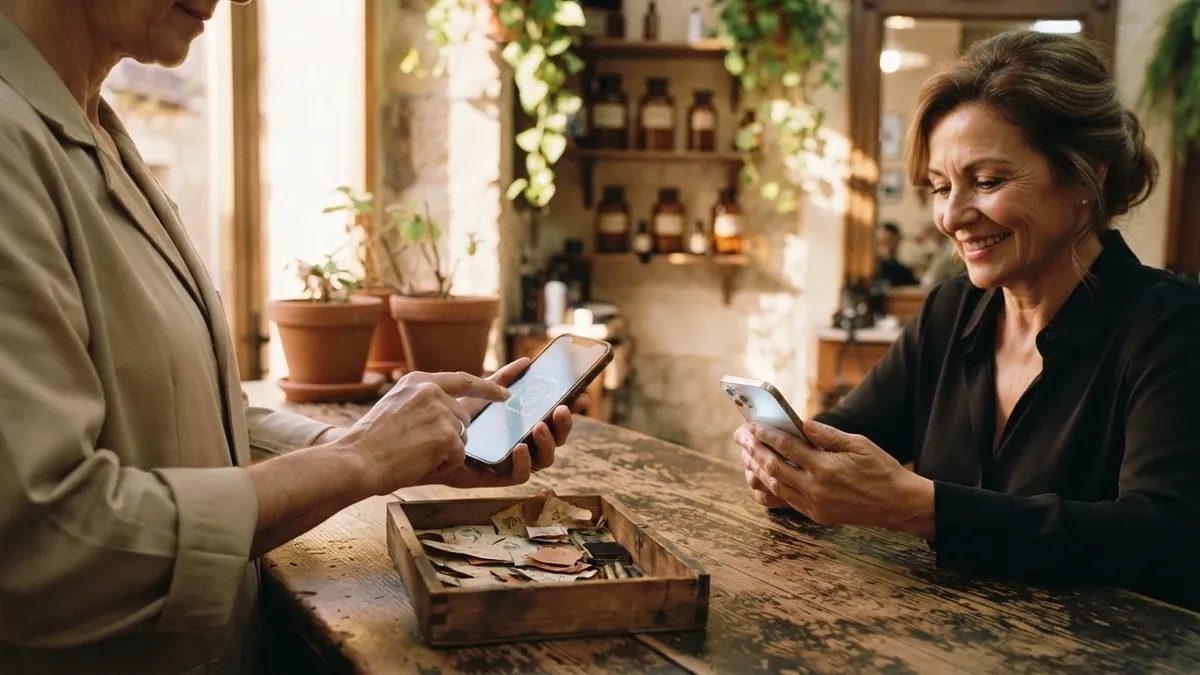
To be fair, the digital card has one drawback: the odd older client, or someone who doesn't get on with phones, will prefer paper. There's no harm in running both for a while. Most people switch on their own once they see they don't have to remember anything.
Clear rules from day one
Stamp cards cause few arguments, but the few there are almost always come from rules the client didn't know about. Before you launch, decide these and write them down:
- What earns a stamp. A visit, a service over a certain amount, or any purchase. The easiest to explain is «one stamp per visit».
- Whether it expires. If you set an expiry date, make it a long one and mention it when you hand over the card. A card that expires without warning is an annoyed client.
- Whether it can be shared. In a family hair salon, it's common for a mother and daughter to want to pool their stamps. Decide whether you allow it before you're asked.
- How it's redeemed. Whether the reward has to be booked or works on any visit.
Put it in one sentence at the counter or in your app and you won't have to explain it every time.
How to offer it so clients sign up
The best card in the world is no use if nobody offers it. The moment is at the till, and the line needs to be short and not sound like a sales pitch:
«Shall I sign you up to the card? After eight cuts, the next one's free, and you get two welcome stamps today. I just need your phone number.»
Three things: the reward put in numbers, the welcome stamps (and you now know why they work), and how little it asks of the client. If you tend to forget to offer it when things get busy, a small sign by the card reader works as a reminder.
And make the most of the moment they claim the reward. The café study showed that once customers redeem it, they slow back down. To stop that happening, add the first stamp of the new card on the same day they claim their reward, and tell them how many they need for the next one. That way they never start from zero.
Mistakes that stop anyone completing the card
- Too many stamps for how often clients visit. The number one mistake. If the reward is more than six months away, shorten the card.
- A reward nobody wants. If clients react to the card with a shrug, the reward isn't doing its job.
- Forgetting to stamp. Once is enough for a client to stop trusting it. If the card is digital, stamp before taking payment, as part of the routine.
- Changing the rules halfway. If you have to change them, apply the new ones to new cards only.
- Not using the data. If you know who is about to complete their card and do nothing with it, you're wasting the best part of having it digital.
How to set up your stamp card with AppMyBusiness
With AppMyBusiness, the stamp card lives inside your business's own app, the same app where your clients book their appointments. Here's how it works:
- In your dashboard, go to Loyalty and switch the card on.
- Choose how many stamps are needed (from 2 to 50), write the reward and pick the stamp icon.
- When a client comes in, look up their phone number in the dashboard and tap to add the stamp. If it's their first time, they're signed up with that first stamp. For the two welcome stamps, tap twice.
- Your client opens your app, taps their card, enters their phone number and sees how many stamps they have and how many are left for the reward.
- When the card is full, the dashboard lets you know and you redeem the reward with one tap.
The stamp card is part of the Pro plan, which costs €9.90 a month including VAT (or €99 a year), with no commitment. The same plan includes push notifications to your clients' phones, which you can use to remind everyone the card exists or announce a double-stamp month. For the client who is one stamp short, the dashboard list tells you who they are, and a WhatsApp message with their name does the rest. If you'd like to try the app with bookings first, the free plan has unlimited appointments and you can move to Pro whenever you like.
If you run a barbershop, a hair salon, a beauty salon or a café, there's a template designed for your trade. You can build your app for free and see how it looks in a few minutes.
And if you want to go beyond the card, our articles on how to build customer loyalty with an app and our guide to push notifications for local businesses cover the rest of the strategy for getting clients to come back.
Frequently asked questions
How many stamps should a loyalty card have?
It depends on how often your clients come back. Ideally the card should take three to six months to complete: around 10 stamps for a café, 6 or 8 for a barber and 4 or 5 for a hair salon that clients visit every six weeks or so. If in doubt, go for the lower number.
Do stamp cards really work?
Yes, and it has been measured. At a café, the time between one purchase and the next shrank by 20 % on average as customers got closer to the reward. At a car wash, giving away the first two stamps meant 34 % of customers completed the card, compared with 19 % with an empty card.
What reward should a hair salon or barber loyalty card offer?
A full free service, such as a haircut, is the easiest to understand. A service the client doesn't usually book, such as a treatment or an eyebrow shape, also works well: it costs you little and gets them to try something new. Small percentage discounts tend to motivate very little.
Is a digital stamp card better than a paper one?
A paper card is cheap, but it gets lost, can be faked and gives you no information. A digital card is tied to the client's phone number, can't be lost, shows their progress on their phone and tells you who is about to earn the reward so you can remind them.
How do I create a digital stamp card for my business?
With a loyalty app or with your own business app that includes one. In AppMyBusiness you switch it on from the dashboard, choose the number of stamps and the reward, and stamp by looking up the client's phone number. It's included in the Pro plan, at €9.90 a month including VAT.
Sources
- Kivetz R., Urminsky O. and Zheng Y. The Goal-Gradient Hypothesis Resurrected: Purchase Acceleration, Illusionary Goal Progress, and Customer Retention. Journal of Marketing Research, 2006.
- Nunes J. C. and Drèze X. The Endowed Progress Effect: How Artificial Advancement Increases Effort. Journal of Consumer Research, 2006.